How Nonprofits Can Clearly Breakdown Impact: Turning Donations Into Tangible Outcomes That Businesses Understand
Why Clear Impact Metrics Help Nonprofits Attract Corporate Sponsors and Donors
Nonprofits often describe their work in broad terms.
“We protect oceans.”
“We support youth education.”
“We fight hunger.”
All of these statements matter. But when it comes to attracting corporate sponsors, recurring donors, and long-term funding, clarity is hugely important.
Companies and supporters want to understand exactly where their money goes and what impact it has. They want to see measurable results that they can track, communicate, and stand behind.
This is where a simple funding equation becomes powerful.
When nonprofits can clearly show what each dollar achieves, it becomes much easier to secure business partnerships that move the needle for your nonprofit longterm.
What Does “$1 = One Outcome” Mean? A Simple Way to Measure Nonprofit Impact
A dollar-to-outcome model translates donations into clear, tangible results.
It answers the question every donor and corporate partner is asking: What does my money actually achieve?
Examples:
- $1 removes 1 pound of ocean plastic
- $10 plants 5 trees
- $25 provides school supplies for one child for one month
- $100 delivers 100 meals to families in need
This type of nonprofit impact measurement makes outcomes easy to visualize and easy to communicate.
Instead of vague descriptions, supporters see exactly what their funding enables.
For businesses especially, this clarity makes partnerships easier to justify and promote.

Why Corporate Partners Want Measurable Nonprofit Impact
Companies think in metrics. They track performance across marketing, sales, and operations. When they support a nonprofit, they need similar clarity.
If a nonprofit cannot explain what funding achieves, companies struggle to:
- justify sponsorship internally
- build customer campaigns around the partnership
- report results to stakeholders
- commit to recurring support
But when outcomes are clear, everything becomes easier.
Now a company can say:
- Every purchase funds X
- Every booking provides Y
- Every signup supports Z
This turns charitable giving into something tangible and reportable.
For nonprofits looking to secure corporate partnerships, measurable outcomes are often the deciding factor.
How Clear Impact Metrics Increase Recurring Donations and Long-Term Funding
One-time donations are often emotional decisions. Recurring funding is driven by trust, clarity, and structure.
Organizations that secure consistent funding typically:
- show exactly what donations achieve
- provide ongoing reporting
- make results easy to communicate
When donors and corporate partners clearly understand outcomes, they are more likely to continue supporting the organization.
This builds confidence which in turn builds retention.
If supporters cannot easily explain what their money accomplishes, they are far less likely to stay engaged long term.

Measuring Nonprofit Impact and Creating a Clear Funding Equation
Creating a simple and credible impact equation requires real operational data. Here's a practical approach.
Calculate your cost per outcome
Start by identifying the real cost of delivering your core service on a per unit basis.
Include logistics, materials, staffing, travel, reporting, and program costs.
For example, to calculate the cost to plant and maintain one tree, you might sum up the total costs of planting and maintaining a forest of 1,000 trees. Divide this number by 1,000 and you have your cost per single tree.
You can use the same logic for meals donated, children educated, or animals rescued.
This forms the basis of your nonprofit impact metrics.
Break outcomes into simple, shareable units
Convert your costs into clear units that donors and businesses understand instantly.
Keep the math simple and intuitive. The goal is to clarify dollars to impact as quickly and clearly as possible.
$1 = 1 meal donated is incredibly easy to understand.
It's also easy to scale, with a potential donor quickly able to see what a $10 or $100 contribution would achieve.
Ensure credibility and transparency
Your numbers must be realistic and defensible.
Ask:
- Can we deliver this outcome consistently?
- Can we show proof if asked?
- Will partners feel confident sharing this publicly?
Transparent reporting builds long-term trust.
Support metrics with visual proof and storytelling
Impact data alone is not enough. Photos, videos, and updates help supporters connect with results and stay engaged.
This combination of metrics and storytelling is what turns one-time donors into long-term partners.
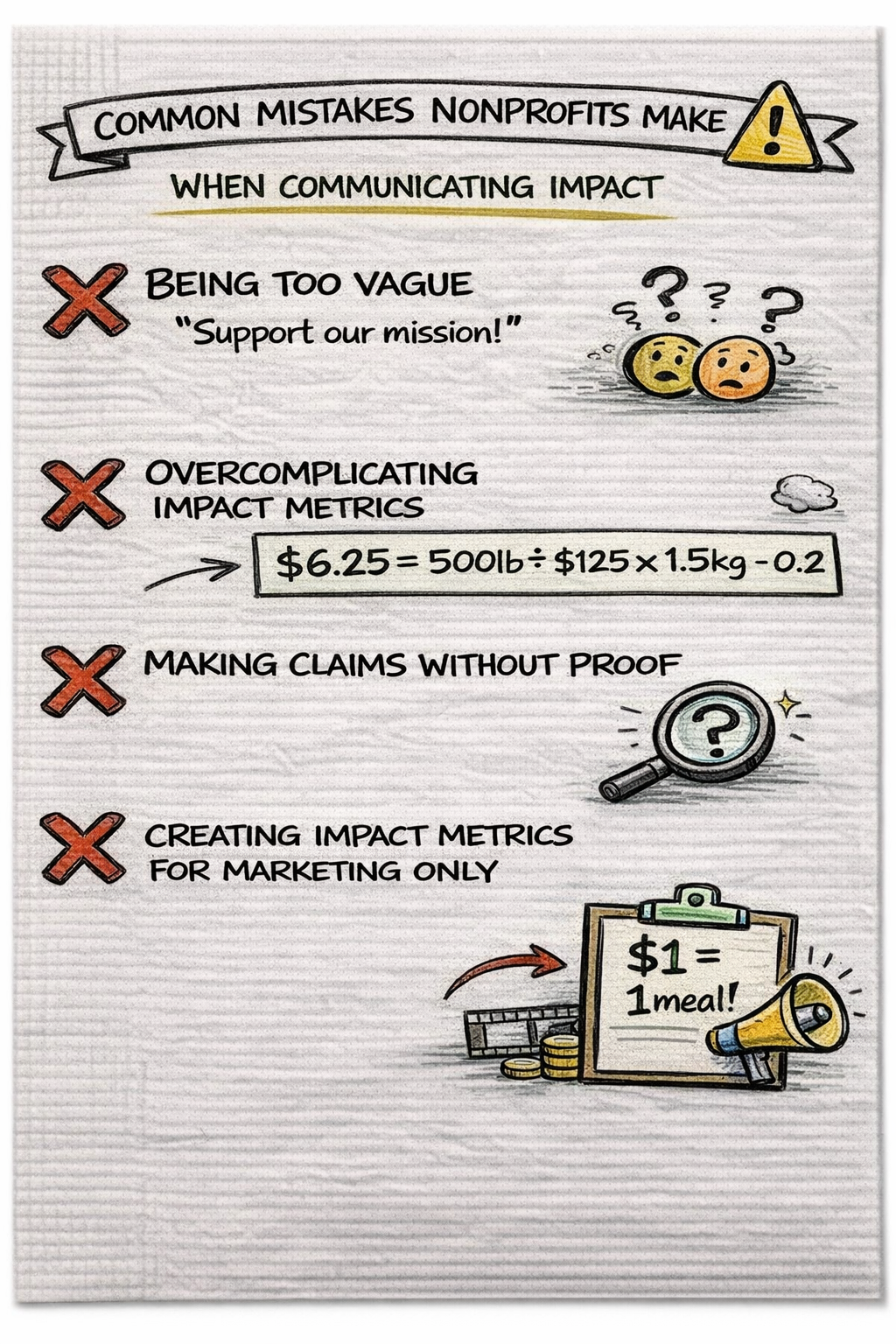
Common Mistakes Nonprofits Make When Communicating Impact
Many organizations attempt to show measurable impact but miss key details.
Being too vague
General statements like “support our mission” do not drive funding.
Overcomplicating impact metrics
If supporters cannot quickly understand your model, they'll fee less comfortable supporting it.
Making claims without proof
All metrics should be backed by real data and reporting.
Creating impact metrics for marketing only
$1 = 1 tree planted is catchy but you should always be careful to reflect real operational outcomes.
Avoiding these mistakes strengthens credibility and increases donor confidence.
How Clear Impact Reporting Helps Nonprofits Secure Better Corporate Partnerships
When nonprofits clearly show what each dollar achieves, partnerships become easier to build and scale.
Businesses can:
- tie purchases to measurable outcomes
- build marketing campaigns around real results
- share updates with customers and employees
- demonstrate social value alongside financial performance
Nonprofits benefit from:
- stronger corporate relationships
- clearer reporting structures
- increased recurring donations
- easier storytelling and promotion
Clear impact reporting turns occasional donors into long-term partners.
Final Thoughts: Nonprofits That Measure and Show Impact Attract More Funding
The nonprofits that grow fastest are often the ones that explain their outcomes most clearly.
When supporters understand exactly what their money achieves, they feel more confident giving and continuing to give.
If your organization cannot yet answer the question “what does $1 actually do?”, start there.
Clear, measurable outcomes make it easier to attract corporate sponsors, retain donors, and scale your mission over time.