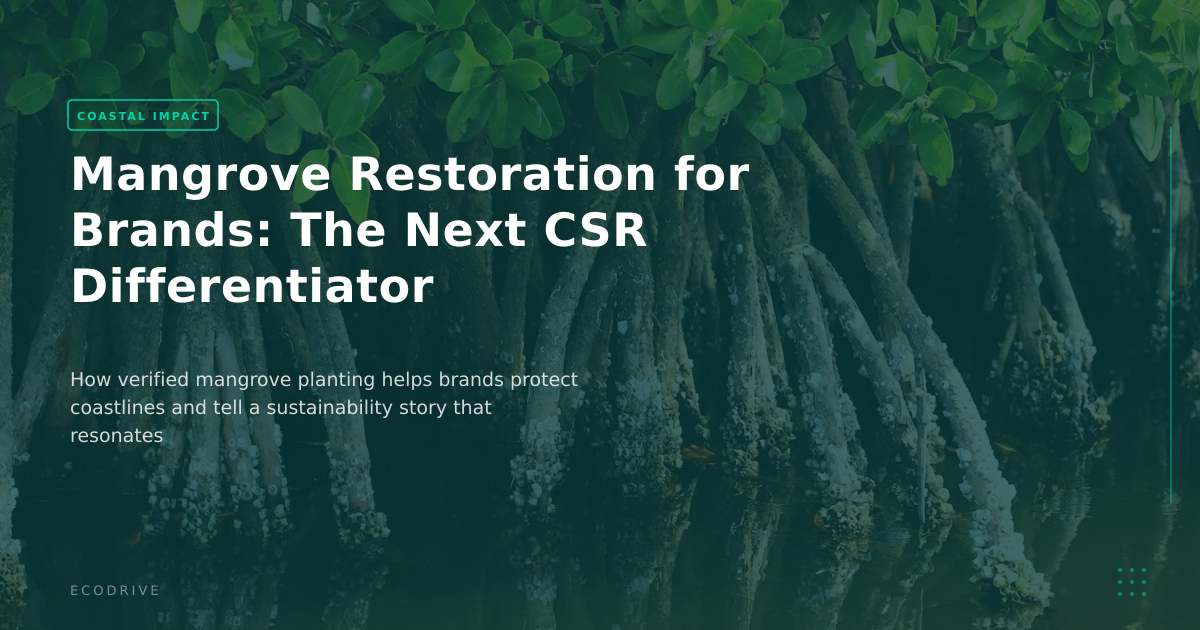
Mangrove Restoration for Brands: Why Coastal Impact Programs Are the Next CSR Differentiator
How verified mangrove planting helps brands protect coastlines, support biodiversity, and tell a sustainability story that resonates
Mangrove Restoration Is One of the Highest-Impact CSR Investments a Brand Can Make
Mangroves protect over 150 million people from coastal flooding, support 80% of global fish catches, and sequester carbon at rates up to 10 times greater than terrestrial forests. For brands building sustainability programs that go beyond generic claims, mangrove restoration offers something rare: verified, measurable impact with a compelling visual story.
Unlike broad environmental pledges that are difficult to prove and easy to challenge, mangrove planting programs produce tangible, trackable results. Every tree planted has GPS coordinates. Every hectare restored has documented biodiversity outcomes. That specificity is exactly what today's consumers, regulators, and investors demand.
Why Mangrove Restoration Stands Out for Brand CSR
Most corporate sustainability programs struggle with the same problem: credibility. Consumers are skeptical of vague "eco-friendly" claims. Regulators are tightening rules around green marketing. Investors want auditable ESG metrics.
Mangrove restoration programs solve this by delivering impact that is inherently verifiable and multi-dimensional:
- Coastal protection. Mangroves reduce wave energy by up to 70%, shielding communities from storms, flooding, and erosion. This is infrastructure-level impact that resonates with stakeholders across the board.
- Marine biodiversity. Mangrove forests are nursery habitats for 70-80% of tropical fish species. Restoring them directly supports fisheries and marine ecosystems that millions of people depend on.
- Community livelihoods. Restoration projects employ local communities in planting, monitoring, and maintaining mangrove forests. The economic benefits extend well beyond the environmental ones.
- Visual storytelling. Mangrove planting is photogenic, specific, and easy to communicate. "We planted 10,000 mangrove trees protecting 5 hectares of coastline" is a far stronger message than "we reduced our environmental footprint."
How Verified Mangrove Programs Work
A credible mangrove restoration program follows a structured process that ensures real, lasting impact:
Site selection and assessment: Not every degraded coastal area is suitable for restoration. Projects evaluate soil conditions, tidal patterns, and local species to identify sites where mangroves will survive and thrive long-term.
Species-appropriate planting: Restoration projects plant native mangrove species suited to the specific site conditions. This isn't a one-species-fits-all approach. The right species mix is critical for survival rates and ecosystem function.
Community engagement: The most successful projects involve local communities as partners, not just laborers. Community ownership drives long-term stewardship and monitoring well beyond the initial planting phase.
Monitoring and verification: Planted mangroves are tracked with GPS coordinates, survival rates are documented, and growth is monitored over time. This data feeds directly into impact reports that brands can share with stakeholders.
Transparent reporting: Brands receive verified impact data showing exactly how many trees were planted, where, and what outcomes were achieved. No guesswork, no vague percentages.
What Makes a Mangrove CSR Program Credible
With greenwashing scrutiny at an all-time high, brands need to evaluate mangrove programs carefully. Here's what separates credible programs from marketing exercises:
- Third-party verification. Impact data should be independently verified, not self-reported by the planting organization alone.
- Transparent methodology. The program should clearly explain how sites are selected, what species are planted, and how survival rates are measured.
- Long-term monitoring. Trees planted and abandoned aren't restoration. Look for programs that monitor survival and growth for years after planting.
- Community integration. Programs that employ and empower local communities have dramatically higher long-term success rates than those that don't.
- Specific, quantifiable claims. "We support mangrove conservation" is weak. "We planted 25,000 mangrove trees across 12 hectares in coastal Indonesia with a 92% survival rate" is defensible.
Integrating Mangrove Restoration into Your Brand Strategy
The most effective mangrove programs aren't standalone CSR initiatives. They're woven into the brand's customer experience and business operations:
- Per-transaction impact. Plant mangrove trees for every purchase, subscription renewal, or customer milestone. This creates a direct, tangible link between customer activity and environmental impact.
- Customer-facing dashboards. Show customers exactly how many trees have been planted through their purchases. Real-time impact tracking builds trust and drives engagement.
- Employee engagement. Mangrove restoration is a powerful employee engagement tool. Teams can track collective impact, participate in planting events, and see their company making a measurable difference.
- Annual impact reports. Publish verified data on trees planted, hectares restored, and communities supported. Use specific numbers and project locations, not percentages and platitudes.
The Business Case for Coastal Ecosystem Investment
Beyond the environmental and social impact, mangrove restoration programs deliver measurable business value:
- Customer acquisition. Sustainability-integrated brands see higher conversion rates among environmentally conscious consumers, a segment growing 15-20% annually.
- Customer retention. Impact visibility creates emotional connection with the brand. Customers who see their personal contribution to mangrove restoration are more likely to remain loyal.
- ESG performance. Verified mangrove restoration strengthens ESG scores and sustainability reports, which increasingly influence institutional investment decisions and B2B procurement.
- Regulatory readiness. As green marketing regulations tighten globally, brands with verified, specific impact programs are better positioned than those relying on vague environmental claims.
Frequently Asked Questions
How many mangrove trees does a typical brand program plant?
Programs range widely based on business size and commitment level. Some brands start with 1,000-5,000 trees annually tied to customer transactions, while larger programs plant 50,000+ trees per year as part of comprehensive sustainability strategies.
Where are mangrove restoration projects located?
Most verified mangrove restoration happens in tropical and subtropical coastal regions, including Southeast Asia, East Africa, Central America, and the Pacific Islands. Project locations are selected based on ecological suitability and community partnership opportunities.
How long does it take for planted mangroves to mature?
Mangrove seedlings typically establish within 1-2 years and begin providing meaningful coastal protection and habitat value within 3-5 years. Full maturity takes 15-25 years, but the ecosystem benefits start accruing much sooner.
How is impact verified?
Reputable programs use GPS-tagged planting records, periodic survival rate audits, and third-party verification. Impact data is documented and made available to brand partners for transparent stakeholder reporting.
Can mangrove restoration be tied to specific products or customer actions?
Absolutely. Many brands tie mangrove planting to per-order, per-subscription, or per-booking triggers. This model creates a direct, communicable link between customer engagement and environmental impact.
Start Building Your Mangrove Restoration Program
Mangrove restoration is one of the most impactful, verifiable, and story-rich sustainability programs a brand can invest in. The science is clear. The business case is strong. The customer appetite is growing.
Ecodrive's verified impact platform makes it easy to integrate mangrove restoration into your brand experience with full transparency, real-time tracking, and third-party verification. Explore Ecodrive's mangrove restoration programs and start building your coastal impact strategy today.